DominionSections
Browse Articles
- IndependentMedia.ca
- MostlyWater.org
- Seven Oaks
- BASICS Newsletter
- Siafu
- Briarpatch Magazine
- The Leveller
- Groundwire
- Redwire Magazine
- Canadian Dimension
- CKDU News Collective
- Common Ground
- Shunpiking Magazine
- The Real News
- Our Times
- À babord !
- Blackfly Magazine
- Guerilla News Network
- The Other Side
- The Sunday Independent
- Vive le Canada
- Elements
- ACTivist Magazine
- The Tyee
- TML Daily
- New Socialist
- Relay (Socialist Project)
- Socialist Worker
- Socialist Action
- Rabble.ca
- Straight Goods
- Alternatives Journal
- This Magazine
- Dialogue Magazine
- Orato
- Rebel Youth
- NB Media Co-op
Radio
Growth at Any Cost
December 1, 2003
Growth at Any Cost
“NAFTA on steroids” a site for protest and paramilitary-style police action
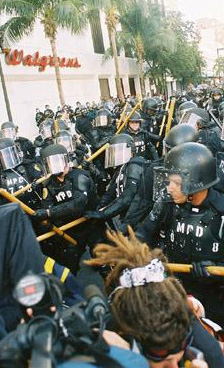
Police charge a crowd of protesters in Miami.
More than 10,000 protesters joined ministers in Miami and marched in circles outside the fence and outside the sight of the negotiators inside. Over 300 were arrested and many more were subjected to rubber bullets, stun grenades, and tear gas. Undercover police used tasers and electric shock guns to arrest demonstrators in the midst of the crowd.
"The police presence was totally excessive and unnecessary given the nature of the protest," said protester Anna Kirkpatrick. "The large number of heavily equipped officers was very intimidating."
The Palm Beach Post declared, "Miami has resembled a city under martial law."
Environmental organizer Ben Trevelin of New York was frustrated by the slant of most media covering the protests. "It's a shame. The violence here will overshadow the real violence of the day at the Intercontinental Hotel[the location of the meeting]."
Inside the hotel, negotiators managed to avoid a collapse of talks, like the one that occurred during the World Trade Organization Ministerial in July, by settling on a compromised agreement. The "FTAA lite" allows countries to decide on varying levels of commitment in each sector of the agreement.
As a result of their limited success negotiating multilateral agreements, the US has been focusing more recently on bilateral or regional pacts, like the Central American Free Trade Agreement (CAFTA). CAFTA, an agreement between the five Central American nations and the US, is expected to be based on the neo-liberal NAFTA. Activists like Wallach are concerned that the economic power of the US will overwhelm the negotiating ability of smaller countries in such deals.
According to the over 10,000 people that gathered in Miami to protest the FTAA, the agreement is bad enough already.
"Somebody ought to be talking about the morality of free trade. They're not talking about it at the meeting inside the hotel," said Reverend Frank O'Laughlin, a Catholic priest who travelled from Lake Worth, Texas, to join the protests. O'Laughlin described the FTAA as "... a trade agreement that will.... make a few people rich at the expense of spreading hemispheric poverty."
Root Cause, a coalition of grassroots organizations based in South Florida that represents immigrant workers, people of colour and other marginalized groups, used Miami as a case study to illustrate the social and environmental impacts of international trade. Their Community Impact Report found that dramatic income disparities lead to a concentration of polluting industries in poor areas.
According to the report, in Dade County, a suburb of Miami, people of colour are three times more likely to be exposed to toxic chemicals than whites. The county also has four times as many Superfund sites (major toxic waste concentrations) per square mile than the rest of Florida, with most of those in communities of colour. Latinos and African-Americans have the highest lifetime cancer risk from hazardous air pollutants, particularly if their income is under $25,000.
"When I would go visit my Aunt Berta there was always the smell of gas fumes presen," said Keith Ivory, a resident of Overtown, Miami. "Years later, Aunt Berta would die of some type of respiratory problem, even though she never smoked. Today I still smell those fumes from People's Gas and I wonder who will be next: a family member, friend, or me."
The draft FTAA contains no provisions or safeguards for environmental security to limit or mitigate these impacts.
A more fundamental ecological critique of such free trade agreements comes from a New Economics Foundation report. The report, titled Collision Course, outlines the conflict between trade agreements and the multilateral environmental agreement to halt climate change, the United Nations Framework Convention on Climate Change.
"International trade is set for a head-on collision with attempts to control global climate change. Trade makes up a growing share of an increasingly fossil fuel-hungry global economy. The transport it depends on is one of the fastest rising sources of greenhouse gas emissions that add to climate change," says the report.
Despite concerns raised by citizen and environmental groups in Miami, many proponents of the FTAA are disappointed that talks aren't moving fast enough. Canada"s Trade Minister, Pierre Pettigrew is one of them.
"We want to move [as] 34 and when you see an absolute resistance to your higher level of ambition, you register it. You may deplore it, you may think it's not the way we should be goin,g but we are quite satisfied that all these elements, investment, and services are remaining on the table."
Although the FTAA negotiations have been slowed by the Miami compromise, January 2005 remains the firm deadline to end negotiations and sign the final agreement, which aims to eliminate "barriers to trade and investment" amongst countries in the Americas and the Caribbean, excluding Cuba.
(With files from Palm Beach Post and the Free Trade of Americas Indymedia.)
Related articles:
By the same author:
Archived Site
The Dominion is a monthly paper published by an incipient network of independent journalists in Canada. It aims to provide accurate, critical coverage that is accountable to its readers and the subjects it tackles. Taking its name from Canada's official status as both a colony and a colonial force, the Dominion examines politics, culture and daily life with a view to understanding the exercise of power.