DominionSections
Browse Articles
- IndependentMedia.ca
- MostlyWater.org
- Seven Oaks
- BASICS Newsletter
- Siafu
- Briarpatch Magazine
- The Leveller
- Groundwire
- Redwire Magazine
- Canadian Dimension
- CKDU News Collective
- Common Ground
- Shunpiking Magazine
- The Real News
- Our Times
- À babord !
- Blackfly Magazine
- Guerilla News Network
- The Other Side
- The Sunday Independent
- Vive le Canada
- Elements
- ACTivist Magazine
- The Tyee
- TML Daily
- New Socialist
- Relay (Socialist Project)
- Socialist Worker
- Socialist Action
- Rabble.ca
- Straight Goods
- Alternatives Journal
- This Magazine
- Dialogue Magazine
- Orato
- Rebel Youth
- NB Media Co-op
Radio
Archive
September 12th, 2003
The Gathering Storm in Mexico
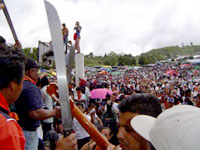
Under NAFTA, Mexican farmers move from ejido to foreign finca*
August 31st
The "Virtual Senate"
August 23rd
How the Liberal Party Works
 In November 2003, Paul Martin will--barring unimaginable circumstances--be chosen as Canada's next Prime Minister. Legally and politically, this choice is not made by the Canadian public at large, but rather by a private club known as the Liberal Party of Canada. Even given that the Liberal Party has over 500,000 members (according to recent reports, a larger membership than any political party in Canadian history), most Canadians will not have a say in this decision. Indeed, it is already too late for anyone who wanted to vote in the party's leadership election -- to vote, members had to join by last June. And if you had the foresight to join the party four months before the election, you also have to pay a membership fee, and be prepared for a potentially long journey on voting day in order to cast a ballot.
We hold elections, but do our political parties practice democracy?

Photons and Formaldehyde: The New Art-Viewing
 In a world where crushed metal, urinals, and stripped paintings all parade under the banner of "fine art", many have cried out against the alienation of the viewer by contemporary art and art-systems. In reaction to this, a new type of art and art-viewing has arrived, based on the all-too-familiar behaviours of consumerism.
Is Climate Change Burning up British Columbia?
 Are the forest fires in Western Canada part of climate change? Scientists say that it is likely, and environmental groups are urging Canadians to begin making the connection between the burning forests and the country's rising greenhouse gas emissions.
 US Terrorism Against Cuba
August 8th

Janet Cardiff & George Bures Miller: Recent Works
Whitechapel Art Gallery, London, U.K.
Sound Art on the Rise in Sackville, N. B.
Anti-Globalization's Disappearing Act

Hundreds of "Green Zone" protesters arrested during WTO ministerial in Montreal
One Citizen, One Vote: Towards Proportional Representation
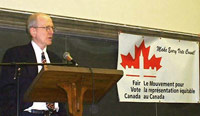
Fair Vote Canada (FVC) was formed in August of 2000 as a multi-partisan citizen's campaign to reform Canada's voting system. FVC promotes the adoption of a system that is proportional, uses positive, effective votes, and results in a stable and accountable government. The organization does not recommend a specific type of proportional representation, but calls for a public process which will allow Canadians to learn about voting system alternatives and choose a new one.
An interview with Larry Gordon, Executive Director of Fair Vote Canada
July 26th
The Explicit Policy of World Domination

The Conceited Empire

NZZ: Mr. Todd, you write that America is economically, militarily, and ideologically too weak to actually control the world. This would gladden many anti-Americans. But how is this anything but the wishful thinking of an intellectual who is the product of the French US critical tradition?
ET: This is neither wishful thinking nor anti-Americanism. Why would I have been so prominently criticised by the left? The French career anti-American paper "Le Monde diplomatique", was the only major paper that remained conspicuously silent on my book. The over-estimation of America is fundamental to these people. It is on this topic that they agree with the American ultra-conservatives: the former to demonize, the latter to aggrandize.
A historian credited with predicting the downfall of the Soviet Union in the 1970s now says that the US has been on its way out for the last decade
Caution: Extreme Shakespeare in Halifax
What Makes Magic in the Park?
Dammed if you do...

HydroQuebec plans diversion of multiple rivers near James Bay
July 10th
Social Torment: Globalization in Atlantic Canada
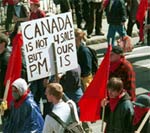 At its core, Thom Workman's thesis is simple: labour is a major cost for businesses of all kinds, and thus an impediment to profits. As such, "transnational capital" seeks constantly to lower the cost of labour; when they do this by breaking down "trade barriers" to gain access to cheap labour or invoke international competitiveness to roll back wages, the process is called globalization. In Social Torment, Thom Workman starts by outlining the history of this shift from the "class compromise" of the twentieth century to the newly invigorated attacks on unions and the working class. And then he does something interesting; rather than spinning together a series of anecdotes to support his case, Workman looks at the numbers.
Excerpts from Thom Workman’s book on neoliberal policy and its effect on workers
Archived Site
The Dominion is a monthly paper published by an incipient network of independent journalists in Canada. It aims to provide accurate, critical coverage that is accountable to its readers and the subjects it tackles. Taking its name from Canada's official status as both a colony and a colonial force, the Dominion examines politics, culture and daily life with a view to understanding the exercise of power.