DominionSections
Browse Articles
- IndependentMedia.ca
- MostlyWater.org
- Seven Oaks
- BASICS Newsletter
- Siafu
- Briarpatch Magazine
- The Leveller
- Groundwire
- Redwire Magazine
- Canadian Dimension
- CKDU News Collective
- Common Ground
- Shunpiking Magazine
- The Real News
- Our Times
- À babord !
- Blackfly Magazine
- Guerilla News Network
- The Other Side
- The Sunday Independent
- Vive le Canada
- Elements
- ACTivist Magazine
- The Tyee
- TML Daily
- New Socialist
- Relay (Socialist Project)
- Socialist Worker
- Socialist Action
- Rabble.ca
- Straight Goods
- Alternatives Journal
- This Magazine
- Dialogue Magazine
- Orato
- Rebel Youth
- NB Media Co-op
Radio
social movements
Record Crowd Demands Closure of "School of Assassins"
Yes Means No!
The Yes Men dish up artistic critique to straight-faced corporate audiences
Arrested Developments
 New York hosts Republicans... and the largest US demonstration in decades
"New York certainly is an exciting city."
Thus remarked Brad Freeman, a Republican delegate from LA, and friend of George W. Bush, regarding the several hundred thousand protestors who flooded Manhattan....
by Isabel Macdonald
New York hosts Republicans... and the largest US demonstration in decades
"I take this as genocide"
Secwepemc battle BC government over land, Aboriginal Title
Small Victory for the Poor and Homeless
El Salvadorans Ask: do we CAFTA?
 "Best hope for success" or imperial power grab? Jen Peirce reports on the Central American Free Trade Agreement from El Salvador.
Raise the Rates: Demonstrators
Divide and Conquer: Bilateral Trade Agreements
 Last September saw the spectacular collapse of World Trade Organization treaty talks in Cancun, Mexico. Joseph Stiglitz, former Chair of Clinton's council of economic advisors and Nobel Prize winner described the talks as "the usual: hard bargaining, extreme positions, last-minute concessions, arm twisting, peer pressure, tacit threats of cutting off development assistance and other benefits, and secret meetings among a small number of participants are all designed to extract concessions from the weakest".
 The US is using a new approach to sidestep developing countries' unified demands
Direct Action: Tre Arrow Arrested
 On March 10th, a man calling himself Joshua Murray was arrested for shoplifting in a Victoria Canadian Tire outlet. According to police, fingerprints identified him as Tre Arrow, an Oregon environmental activist listed on the FBI's most wanted list with a reward of $25 000 for information leading to his arrest.
 FBI labels prominent anti-logging activist as "eco-terrorist"
Venezuela's Political Battle
 David Fuenmayor reports on Venezuela's deep political divide, US intervention, and issues surrounding a potential referendum.
Privatization in South Africa: Starting Over

Citigroup Comes Clean: World's Largest Bank Adopts Landmark Environmental Policy
 In a surprise announcement on January 22nd, Citigroup signaled its intention to adopt a comprehensive environmental policy that even the company's staunchest critics are calling "the most significant environmental commitment to date in the financial services sector."
 Zapatistas and Supporters Celebrate 10 Years of Colourful Resistance

Barn-Raising on Air: the Prometheus Radio Project

Growth at Any Cost
 "NAFTA on steroids" a site for protest and paramilitary-style police action
On November 20th, behind five ranks of riot police, a 10 foot high reinforced fence, water cannons, and light armoured vehicles, ministers representing thirty-four countries agreed to a "lite" version of the Free Trade Agreement of the Americas (FTAA).
“NAFTA on steroids” a site for protest and paramilitary-style police action
Cheam People Shut Down Railway and Halt Logging
 At about 4 pm on October 2nd two trucks pulled to a halt while straddling the railway tracks that bisect the Cheam Reserve. A small crowd, including members of the Cheam Nation and supporters from local communities, gathered around the trucks forming a human blockade against the trains. Earlier that day, elder and former Chief June Quipp had warned Canadian National Railways that trans-Canadian train travel would be halted, and that she was good on her word.
 A saga of resistance
The "Piquetes"
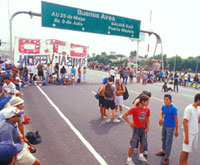 When Argentina's economy collapsed in January of 2002, thousands of Argentinians lost their jobs, and others lost their life savings when foreign banks closed suddenly. In the face of massive unemployment which existed well before the collapse, unemployed workers formed collectives to democratically petition the government for temporary employment ("plans"). After being consistantly ignored, the poorest of the unemployed, often starving, began to set up roadblocks (piquetes) on important Argentinian roads in support of their demands for work. They have also set up bakeries, bartering systems, and occupied abandoned factories and restarted business as usual--without the owners and with a radically democratic model of organizing.
Argentina's unemployed build direct democracy for basic needs
Anti-Globalization's Disappearing Act

Hundreds of "Green Zone" protesters arrested during WTO ministerial in Montreal
Social Torment: Globalization in Atlantic Canada
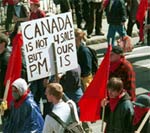 At its core, Thom Workman's thesis is simple: labour is a major cost for businesses of all kinds, and thus an impediment to profits. As such, "transnational capital" seeks constantly to lower the cost of labour; when they do this by breaking down "trade barriers" to gain access to cheap labour or invoke international competitiveness to roll back wages, the process is called globalization. In Social Torment, Thom Workman starts by outlining the history of this shift from the "class compromise" of the twentieth century to the newly invigorated attacks on unions and the working class. And then he does something interesting; rather than spinning together a series of anecdotes to support his case, Workman looks at the numbers.
Excerpts from Thom Workman’s book on neoliberal policy and its effect on workers
- « first
- ‹ previous
- 1
- 2
- 3
- 4
Archived Site
All Topics
The Dominion is a monthly paper published by an incipient network of independent journalists in Canada. It aims to provide accurate, critical coverage that is accountable to its readers and the subjects it tackles. Taking its name from Canada's official status as both a colony and a colonial force, the Dominion examines politics, culture and daily life with a view to understanding the exercise of power.