DominionSections
Browse Articles
- IndependentMedia.ca
- MostlyWater.org
- Seven Oaks
- BASICS Newsletter
- Siafu
- Briarpatch Magazine
- The Leveller
- Groundwire
- Redwire Magazine
- Canadian Dimension
- CKDU News Collective
- Common Ground
- Shunpiking Magazine
- The Real News
- Our Times
- À babord !
- Blackfly Magazine
- Guerilla News Network
- The Other Side
- The Sunday Independent
- Vive le Canada
- Elements
- ACTivist Magazine
- The Tyee
- TML Daily
- New Socialist
- Relay (Socialist Project)
- Socialist Worker
- Socialist Action
- Rabble.ca
- Straight Goods
- Alternatives Journal
- This Magazine
- Dialogue Magazine
- Orato
- Rebel Youth
- NB Media Co-op
Radio

October in Review, Part I
Voting in Canada, money in Afghanistan, oily resignations and mad scientists
Obama's Ground Game: you can't go back
Al Giordano: If Obama wins, what next?
What will become of 10,000-plus (mostly) young organizers earning their subsistence keep working on this campaign after Election Day?
They've been trained well in the resurrected art of community organizing. It would be a shame if they just up and went to grad school instead of applying their new trade. How do we help make sure they don't scatter to the wind and can instead continue harnessing it in harmony with the new political majority about to emerge?
Morning After Talking Points

CKUT's Wednesday Morning After invited me to come and talk about the elections bright and early this morning. Voici mes talking points, albeit in more articulate form, not that I got to all of them:
- Proportional representation is on a lot of people's minds, but it's not going to happen. If it can't be passed at a provincial level (so far, BC, PEI and Ontario have voted no) then it won't happen nationally, as neither the Libs or Cons will be likely to support it (this is an interesting footnote, though).
- If that's true, the Green Party has to do some thinking at this point. A spot in the debates, more media coverage than ever, no seats.
- No matter who people vote for, indications are that we're not going to see anything even beginning to address colonial policies in Canada.


Olmert Admits Israel Must Withdraw
Israel/Palestine- Ehud Olmert passes leadership of the Kadima Party to Tzipi Livni and leaves a challenging legacy. In comments he made during an interview with Israeli newspaper Yediot Ahronot, Olmert admits Israel must withdraw from areas of the West Bank, East Jerusalem, and even the Golan Heights, an area at the center of the Israeli-Syrian dispute.


Pain Compliance as Indigenous Relations
Inside the Barriere Lake Algonquins' blockade of highway 117
Update - massacre 'imminent': Indigenous uprising continues in Colombia

This just in from Mario Murillo:
"...all the communities gathered in the locality of La Maria, in the department of Cauca, are completely surrounded by the Colombian Army. Apparently, the security forces are preparing to carry out an armed assault against the civilians involved in the protest, which began on Sunday, October 12th. Organizers estimate that there are over 10,000 people currently at La Maria and surrounding areas."
After a two-day minga, or popular mobilization which included the participation of over 12,000 people in the Cauca region of Colombia, Indigenous movements are continuing to maintain highway blockades and demand justice and reparations.
From today's communiqué:
"We are risking life for liberty. We have dignity and we reclaim respect. The order that has obligated to take these actions is violent. We are not prepared to continue dying alive. No More."
Other sectors have announced or enacted their solidarity with the Indigenous uprising in Cauca including workers' unions, and the striking sugar cane sector. They are currently asking folks to put pressure on the Colombian government to ensure that their resistance is not met with brute force. Update: your support is urgently needed. Please take a moment to write or fax the Colombian ambassador, Jaime Girón Duarte.
To contact the Colombian Embassy in Canada:
360 Albert Street, Suite 1002
Ottawa, ON. - K1R 7X7
Tels: (613) 230-3760/1
Fax: (613) 230-4416
Email: embajada@embajadacolombia.ca
PHOTO: Solidarity Blockade Slows Spirit Train
By Lia Tarachansky and Jesse Freeston
Vaughan, ON- On Thanksgiving Sunday, October 12th, 2008 roughly two dozen protesters blockaded the Canadian Pacific Rail just north of Toronto.
The blockade began at 5:30 p.m. and ended just after 8:00 p.m. Winnie Small, 20, attached herself to the rails in order to delay removal by police.
Alex Hundert, police liaison for the varied group of protesters, negotiated with the local police service, which was taken by surprise by the bridge blockade.
The group, consisting of Anti-War @ Laurier organizers, native organizers from the Six Nations reservation by Caledonia, and various individuals, was allowed to leave the blockade without arrests or conflict.
According to the police, who were in communications with CP rail on site, the blockade caused millions of dollars of economic damage and delayed trains all along the rail line.
Please stay tuned for The Real News Network video report later this week
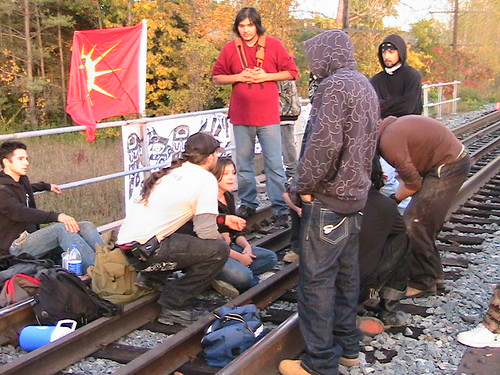
Blockaders Set up lock down
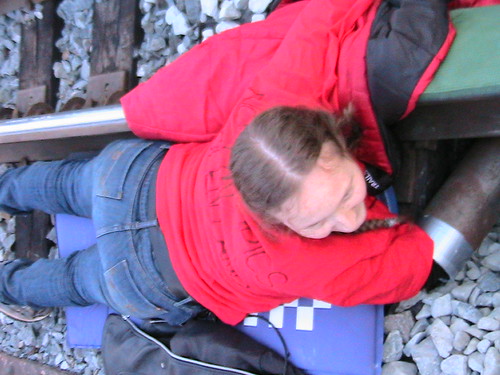
Winnie Small, 20, locked down to the tracks with a "v" shaped metal bar
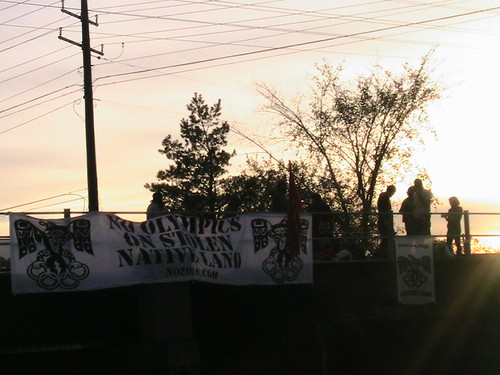
"No Olympics on Stolen Native Land" banner laid out by protesters
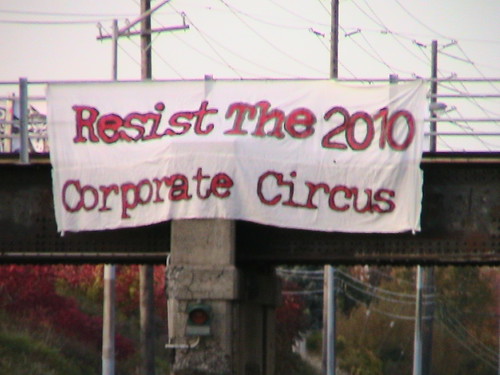
» continue reading "PHOTO: Solidarity Blockade Slows Spirit Train"


The Anti-Terrorist Battle Inside Canada's Borders
The anti-terrorist battle inside Canada's borders
by David Parker
July 17th, 2008.
HALIFAX - In Canada since 9/11, the domestic climate of rising national security fears, fanned by a sensationalist media trumpeting the “War on Terror”, has led the government to justify practices which undermine long-standing principles of human rights.
In December 2001, Canada passed the Anti-Terrorist Act (ATA) to deal with threats to national security. The ATA makes changes to the criminal code that “aim to disable and dismantle the activities of terrorist groups and those who support them”. It destroys civil liberties and gives police vast new powers, eroding due process and privacy. [1]
According to Gary Kinsman, professor at Laurentian University, the concept of ‘national security’ is doubly problematic. Nation refers here to groups who fit the image of the Canadian state - white heterosexual males, construed as ‘safe’, while racialized communities are excluded as ‘outsiders’ and enemies of the state. [2] Despite purported concern with security, state initiatives have only endangered non-citizens and criminalized legitimate social protest.
The arrest of 21 South Asian Muslim men for allegedly plotting to blow up a nuclear reactor in 2003 (known as Project Thread) garnered wide media attention. All were eventually deported on minor immigration charges, not one was charged with a terrorist offence [3]. They were detained up to 5 months, interrogated about their faith and threatened with deportation to Guantanamo Bay, infamous torture camp of the United States, where Omar Khadr, youngest detainee and Canadian citizen, remains after 6 years, subjected to torture methods detailed in leaked FBI files [4].
» continue reading "The Anti-Terrorist Battle Inside Canada's Borders"
Criminalizing Indigenous Rights in Canada
Criminalizing Indigenous Rights in Canada
David Parker
September 8th, 2008.
HALIFAX - In September of 2007, the United Nations adopted the non-binding Declaration on the Rights of Indigenous Peoples. Four high profile countries notably voted against the declaration - namely Canada, the United States, Australia and New Zealand.[1] All four countries are states that were established by white settlers on indigenous lands, and all four are currently in disputes with indigenous peoples over land and sovereignty.
The Canadian state, built on the theft and occupation of indigenous lands, continues to benefit from its unjustly acquired assets. Equipped with an ultra-security state apparatus, Canada's repressive and suppressive anti-terrorist and security measures have historically struck hardest against those that have the most to gain, namely aboriginal nations and their legitimate claims for their rights to land and dignity.
Recent cases of indigenous protest in Ontario have been in opposition to government authorized resource extraction on native lands. Despite legitimate demands for sovereignty and decision-making power over their traditional lands, native protesters have been incarcerated: Robert Lovelace and the KI-6 (6 council members of Kitchenuhmaykoosib Inninuwug First Nation) have received harsh fines and 6 months in jail for peacefully protesting against mineral exploration on the lands of KI and Ardoch Algonquin First Nation (AAFN).
» continue reading "Criminalizing Indigenous Rights in Canada"

Chiefs of Ontario intervene for Barriere Lake

Chiefs of Ontario intervene on behalf of Barriere Lake Algonquins.
Please see attached

Not In Anyone’s Backyard
Farmers in Alberta growing rural resistance to development


.thumbnail.jpg)


Video: Algonquin Blockade Attacked by Police
NOTE: NORMAN MATCHEWAN, SPOKESPERSON FOR THE BARRIERE LAKE ALGONQUINS WAS PUBLISHED TODAY IN THE MONTREAL GAZETTE!
» continue reading "Video: Algonquin Blockade Attacked by Police"
Archived Site
The Dominion is a monthly paper published by an incipient network of independent journalists in Canada. It aims to provide accurate, critical coverage that is accountable to its readers and the subjects it tackles. Taking its name from Canada's official status as both a colony and a colonial force, the Dominion examines politics, culture and daily life with a view to understanding the exercise of power.