DominionSections
Browse Articles
- IndependentMedia.ca
- MostlyWater.org
- Seven Oaks
- BASICS Newsletter
- Siafu
- Briarpatch Magazine
- The Leveller
- Groundwire
- Redwire Magazine
- Canadian Dimension
- CKDU News Collective
- Common Ground
- Shunpiking Magazine
- The Real News
- Our Times
- À babord !
- Blackfly Magazine
- Guerilla News Network
- The Other Side
- The Sunday Independent
- Vive le Canada
- Elements
- ACTivist Magazine
- The Tyee
- TML Daily
- New Socialist
- Relay (Socialist Project)
- Socialist Worker
- Socialist Action
- Rabble.ca
- Straight Goods
- Alternatives Journal
- This Magazine
- Dialogue Magazine
- Orato
- Rebel Youth
- NB Media Co-op
Radio
Features

Contemporary Currents of Quebec’s Student Movement
An interview with Sophie Schoen of L'Association pour une Solidarité Syndicale Étudiante (ASSÉ)

Marmato’s Gold Bonanza
Canadian Mining Firm Involved in ‘Economic Forced Displacement’ in Colombia

Impacting Unimpaired
New agreements like the SPP and TILMA are aimed directly at unimpeded extraction in the tar sands

What the Tar Sands Need
Processing requires massive inputs of water, energy, land, labour

Defending "Life and Sovereignty"
Ecuador’s mining prospects, Canadian companies, and the conflict with affected communities
Grilled Cheese and War Crimes
 Chris Arsenault chats with an average 23-year-old who's hoping Canada won't send him back to the US to fight in a war he doesn't believe in.
US soldier who refuses assignment in Iraq claims refugee status in Canada
Last Gas
 Hillary Bain Lindsay asks why Eastern Canada is being flooded with proposals for liquefied natural gas terminals, and why so many communities are resisting them.
Can natural gas reserves keep up with soaring consumption?
'Measured' Misery?
 Prime Minister Harper called Israel's attack on Lebanon 'measured.' Chris Arsenault talks to a father who hopes his family is still safe.
 Canada and the war between Israel and Hezbollah
Deport Injustice
 Protesters across Canada demand status for all undocumented people. Sarah Rogers finds out why.
Protests across Canada demand status for all undocumented people
A little story about direct action against the third largest corporation in Canada
Non-Status Quo
 After ten non-status Alergians and two supporters are found not guilty, Gordie Warnoff questions the reasons for the brutal arrests.
Years after being brutally arrested, ten non-status Algerians and two supporters are found not guilty
Bordering On Apartheid
 Hillary Bain Lindsay talks to Abdulkader Belaouni about his struggle for justice and permanent status in Canada.
Challenging immigration control in Canada
The Battle of New Orleans
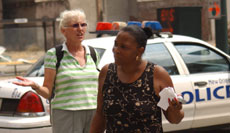 In an extensive overview, Dru Oja Jay looks at the history of race and class iniquities that set the scene for the current tragedy.
Race, Class Disparity Set Stage for New Orleans Disaster
Copper vs. Ecology in Junín
 Stuart Schussler visits the Ecuadorian community of Junín, where Vancouver-based Ascendant Copper has met with strong local opposition.
Canadian Mining Company Preaches Development, Reaps Division in Ecuadorian Cloud Forest
Violence, Poverty Underscore Story of Iraqi Refugees in Jordan
 In Jordan, Jon Elmer describes the plight of thousands of Iraqi refugees.
On Iraq-Jordan Border, Various Roles Play Out in Desert
 Jon Elmer speaks to truckers, soldiers, shopkeepers and migrant workers at the edge of the occupation of Iraq.
Engineering for a Small Planet
 How, exactly, does one leave an established corporate job to do something less "soul killing"? Amanda Jernigan spoke to Kim Paradis to find out.
A Conversation with Kim Paradis
From the Tap to the Bottle and Back Again
 Manufacturers of bottled water are taking over municipal water systems while bottling public water for a profit, says Leah Orr
A look at bottled water and privatization
Photo Essay: Zapatistas
 11 years after what the New York Times called the first "post modern revolution", Chris Arsenault brings back words and images from Chiapas, Mexico.
Reflecting on Ten Years of Resistance in Chiapas
Multiculturalism: It Hurts Us All
Susana Ferreira explores Toronto's underground economy, and the real effects of Canada's "multicultural" policies.
Why Canada isn't, never was, and probably never will be a multicultural nation
Arrested Developments
 New York hosts Republicans... and the largest US demonstration in decades
"New York certainly is an exciting city."
Thus remarked Brad Freeman, a Republican delegate from LA, and friend of George W. Bush, regarding the several hundred thousand protestors who flooded Manhattan....
by Isabel Macdonald
New York hosts Republicans... and the largest US demonstration in decades
Canada in Haiti
 Who Engineered the Overthrow of Democracy?
Anthony Fenton digs into Canada's role in the overthrow of a democratic government in Haiti, and the players involved. His investigation raised questions. Among others: was Canada's involvement to diplomatic enabling, or have Canadian troops been directly involved in the hundreds of political assassinations that followed the coup?
Who Engineered the Overthrow of Democracy?
Canada, Empire
Humanitarianism, peacekeeping, and other myths

Accounts Unsettled
 The past two weeks have seen a remarkable effort on the part of the US government and numerous media outlets to directly contradict reality. The single most remarkable instance of the contradiction came from US military spokesman Mark Kimmitt, who said that "the stations that are showing Americans intentionally killing women and children are not legitimate news sources. That is propaganda, and that is lies."
Independent reporting from Iraq
Divide and Conquer: Bilateral Trade Agreements
 Last September saw the spectacular collapse of World Trade Organization treaty talks in Cancun, Mexico. Joseph Stiglitz, former Chair of Clinton's council of economic advisors and Nobel Prize winner described the talks as "the usual: hard bargaining, extreme positions, last-minute concessions, arm twisting, peer pressure, tacit threats of cutting off development assistance and other benefits, and secret meetings among a small number of participants are all designed to extract concessions from the weakest".
 The US is using a new approach to sidestep developing countries' unified demands
Is "Fighting to Win" a Criminal Act?
[From a talk given by John Clarke in Halifax last December, at a public discussion on the criminalization of dissent.]
 If we're talking about the criminalization of dissent, the first thing that must occur to us when we look at those kinds of examples is that we live in an insane world, where people who go out and challenge injustice are the ones who must defend themselves from the charge of being criminals.
When we marched on the Legislature, back in Toronto, we were aware that so far that year, 22 homeless people had died on the streets of Toronto. When it comes to the crimes of the G7, even the known ones would fill volumes. Those that we don't know about would probably fill volumes more.
To say that anyone who stands up against such acts of theft and murder and violence - and fights back against them - must defend themselves from the charge of being criminal is astounding, and insane. We should keep that in mind.
OCAP's John Clarke on the "Queen's Park Riot" and the changing rules of class warfare
Paul Martin, Ethics and Democracy

Duff Conacher is the Coordinator of Democracy Watch, an Ottawa-based group that has advocated for "democratic reform, government accountability and corporate responsibility" for a decade.
What can we learn from Paul Martin's past record on ethics and democratic reform?
That Martin has lied about maintaining high ethical standards, that he has broken ethics rules, and that he surrounds himself with corporate lobbyists, all of whom are representing corporations that have specific private interests that are not the public interest. And so he is tied directly to the private interests of several corporations in Canada.
An Interview with Democracy Watch's Duff Conacher
What if we Gave it Away?
Citizenship as "contribution" and alternative economies

The box is economy. The dominant economy–capitalism–is only one among many possible models of social organization. How we think about economy and how we structure our activities as economies shapes what we think a contribution is, what kinds of activities are contributions, and who a contributor is.
Citizenship as "contribution" and alternative economies
Lo Que Hemos Aprendido

The Right Whale Program of Peninsula Valdes
Archived Site
All Sections
The Dominion is a monthly paper published by an incipient network of independent journalists in Canada. It aims to provide accurate, critical coverage that is accountable to its readers and the subjects it tackles. Taking its name from Canada's official status as both a colony and a colonial force, the Dominion examines politics, culture and daily life with a view to understanding the exercise of power.