DominionSections
Browse Articles
- IndependentMedia.ca
- MostlyWater.org
- Seven Oaks
- BASICS Newsletter
- Siafu
- Briarpatch Magazine
- The Leveller
- Groundwire
- Redwire Magazine
- Canadian Dimension
- CKDU News Collective
- Common Ground
- Shunpiking Magazine
- The Real News
- Our Times
- À babord !
- Blackfly Magazine
- Guerilla News Network
- The Other Side
- The Sunday Independent
- Vive le Canada
- Elements
- ACTivist Magazine
- The Tyee
- TML Daily
- New Socialist
- Relay (Socialist Project)
- Socialist Worker
- Socialist Action
- Rabble.ca
- Straight Goods
- Alternatives Journal
- This Magazine
- Dialogue Magazine
- Orato
- Rebel Youth
- NB Media Co-op
Radio
Features
Understanding Cuba
- Cuba: A revolution in motion
by Isaac Saney
Fernwood Books 2003
Aside from the cigars and music, these are a few of the well-worn images of Cuba that Isaac Saney, a history professor at Dalhousie, would like you to reconsider.
Revolution and Misinformation
Israelis Criticizing Israel
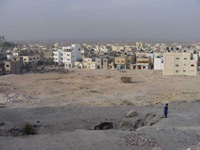 Public debate about Israel tends to be framed in terms of Israel as a unified country and its foreign opponents, anti-Zionist, anti-Semitic and otherwise. Widely ignored are the Israeli intellectuals and leaders who are strongly opposed to their country's actions, and the accounts that inspire their strong opposition.
Independent Canadian journalists Jon Elmer and Valerie Zink are currently reporting from the West Bank and Gaza. The following is a series of excerpts from interviews they have conducted with diverse critical voices within Israel. The full interviews and other coverage can be read on their web site, FromOccupiedPalestine.org.
The occupation of Palestine from the inside, out
Freedom of the Press is for Those Who Own One
 The Irving Media Monopoly in New Brunswick
Living in New Brunswick where all of the English language daily papers are owned by one company means that there is very little variety in the type of news that is available to New Brunswick readers. We face classic problems of monopoly media ownership in which homogeneity and a narrow range of opinion are common features of the news media.
The Irving Media Monopoly in New Brunswick
"Anybody but Bush"
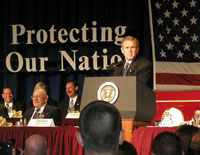 The relationship between Canada and the US has been rocky since George W. Bush took office. Some have blamed this on a personal disconnect between Jean Chretien and President Bush. For example, in March 2003 Liberal MP David Pratt said "I don't think things will change until our leadership changes"--i.e., when Chretien leaves office. Many pundits and politicians agree with Mr. Pratt.
But is this realistic? Exactly how does the relationship between a Canadian Prime Minister and a US President affect Canada-US relations--and how might upcoming federal elections in both countries change the situation?
Canada-US relations and the next Presidential election
The "Piquetes"
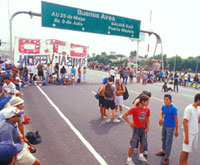 When Argentina's economy collapsed in January of 2002, thousands of Argentinians lost their jobs, and others lost their life savings when foreign banks closed suddenly. In the face of massive unemployment which existed well before the collapse, unemployed workers formed collectives to democratically petition the government for temporary employment ("plans"). After being consistantly ignored, the poorest of the unemployed, often starving, began to set up roadblocks (piquetes) on important Argentinian roads in support of their demands for work. They have also set up bakeries, bartering systems, and occupied abandoned factories and restarted business as usual--without the owners and with a radically democratic model of organizing.
Argentina's unemployed build direct democracy for basic needs
The Gathering Storm in Mexico
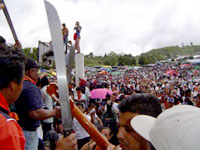
Under NAFTA, Mexican farmers move from ejido to foreign finca*
How the Liberal Party Works
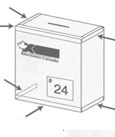 In November 2003, Paul Martin will--barring unimaginable circumstances--be chosen as Canada's next Prime Minister. Legally and politically, this choice is not made by the Canadian public at large, but rather by a private club known as the Liberal Party of Canada. Even given that the Liberal Party has over 500,000 members (according to recent reports, a larger membership than any political party in Canadian history), most Canadians will not have a say in this decision. Indeed, it is already too late for anyone who wanted to vote in the party's leadership election -- to vote, members had to join by last June. And if you had the foresight to join the party four months before the election, you also have to pay a membership fee, and be prepared for a potentially long journey on voting day in order to cast a ballot.
We hold elections, but do our political parties practice democracy?
One Citizen, One Vote: Towards Proportional Representation
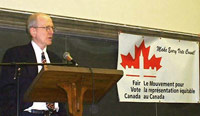
Fair Vote Canada (FVC) was formed in August of 2000 as a multi-partisan citizen's campaign to reform Canada's voting system. FVC promotes the adoption of a system that is proportional, uses positive, effective votes, and results in a stable and accountable government. The organization does not recommend a specific type of proportional representation, but calls for a public process which will allow Canadians to learn about voting system alternatives and choose a new one.
An interview with Larry Gordon, Executive Director of Fair Vote Canada
The Conceited Empire
NZZ: Mr. Todd, you write that America is economically, militarily, and ideologically too weak to actually control the world. This would gladden many anti-Americans. But how is this anything but the wishful thinking of an intellectual who is the product of the French US critical tradition?
ET: This is neither wishful thinking nor anti-Americanism. Why would I have been so prominently criticised by the left? The French career anti-American paper "Le Monde diplomatique", was the only major paper that remained conspicuously silent on my book. The over-estimation of America is fundamental to these people. It is on this topic that they agree with the American ultra-conservatives: the former to demonize, the latter to aggrandize.
A historian credited with predicting the downfall of the Soviet Union in the 1970s now says that the US has been on its way out for the last decade
Social Torment: Globalization in Atlantic Canada
 At its core, Thom Workman's thesis is simple: labour is a major cost for businesses of all kinds, and thus an impediment to profits. As such, "transnational capital" seeks constantly to lower the cost of labour; when they do this by breaking down "trade barriers" to gain access to cheap labour or invoke international competitiveness to roll back wages, the process is called globalization. In Social Torment, Thom Workman starts by outlining the history of this shift from the "class compromise" of the twentieth century to the newly invigorated attacks on unions and the working class. And then he does something interesting; rather than spinning together a series of anecdotes to support his case, Workman looks at the numbers.
Excerpts from Thom Workman’s book on neoliberal policy and its effect on workers
Gouging Together a Living
 Most Canadians don't need to be told that bank fees are rising, while interest rates paid on deposits--even in long term savings accounts--have diminished to the point of being inconsequential. Since the early nineties, the "big five" banks in Canada (Toronto Dominion, Royal Bank, Bank of Nova Scotia, Canadian Imperial Bank of Commerce, Bank of Montreal) have been accelerating a collective move away from traditional retail banking, which is based on the premise that depositors lend their money to a bank and receive interest and certain services in return.Instead, the trend has been to charge increasing service fees while moving customers into areas more lucrative for banks such as credit cards, mutual funds, money market accounts, and stock market investments. Simply storing money in chequing and savings accounts is no longer a considered as a mutually beneficial arrangement; it is now a service to be paid for.
 How banks get away with making you pay for your savings account
"A Dream Only American Power Can Inspire"
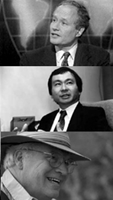 Critics of US foreign policy no longer need to make the argument that the US is trying to undermine the UN and international law, while making active use of global military dominance; the Project for the New American Century is doing it for them. Founded in 1997 on the premise that "too few political leaders today are making the case for [American] global leadership", the Project for the New American Century (PNAC) is a right wing, Washington-based think tank committed to "promoting the idea that American leadership is good both for America and for the world."
 Faces of the New American Century: Francis Fukuyama, William Kristol, Dick Cheney
- « first
- ‹ previous
- 1
- 2
- 3
Archived Site
All Sections
The Dominion is a monthly paper published by an incipient network of independent journalists in Canada. It aims to provide accurate, critical coverage that is accountable to its readers and the subjects it tackles. Taking its name from Canada's official status as both a colony and a colonial force, the Dominion examines politics, culture and daily life with a view to understanding the exercise of power.